Roamwild Arch Window Bird Feeder Review 2026: Should You Buy This?
Bird watching used to mean standing in the cold with binoculars. Now it means sitting at your kitchen table with coffee while a chickadee eats six inches from your face.
That is the promise of a window feeder. The problem is that most window feeders fail. They hold three cups of seed, they leak in the rain, and they slide off the glass at 3am with a crash.
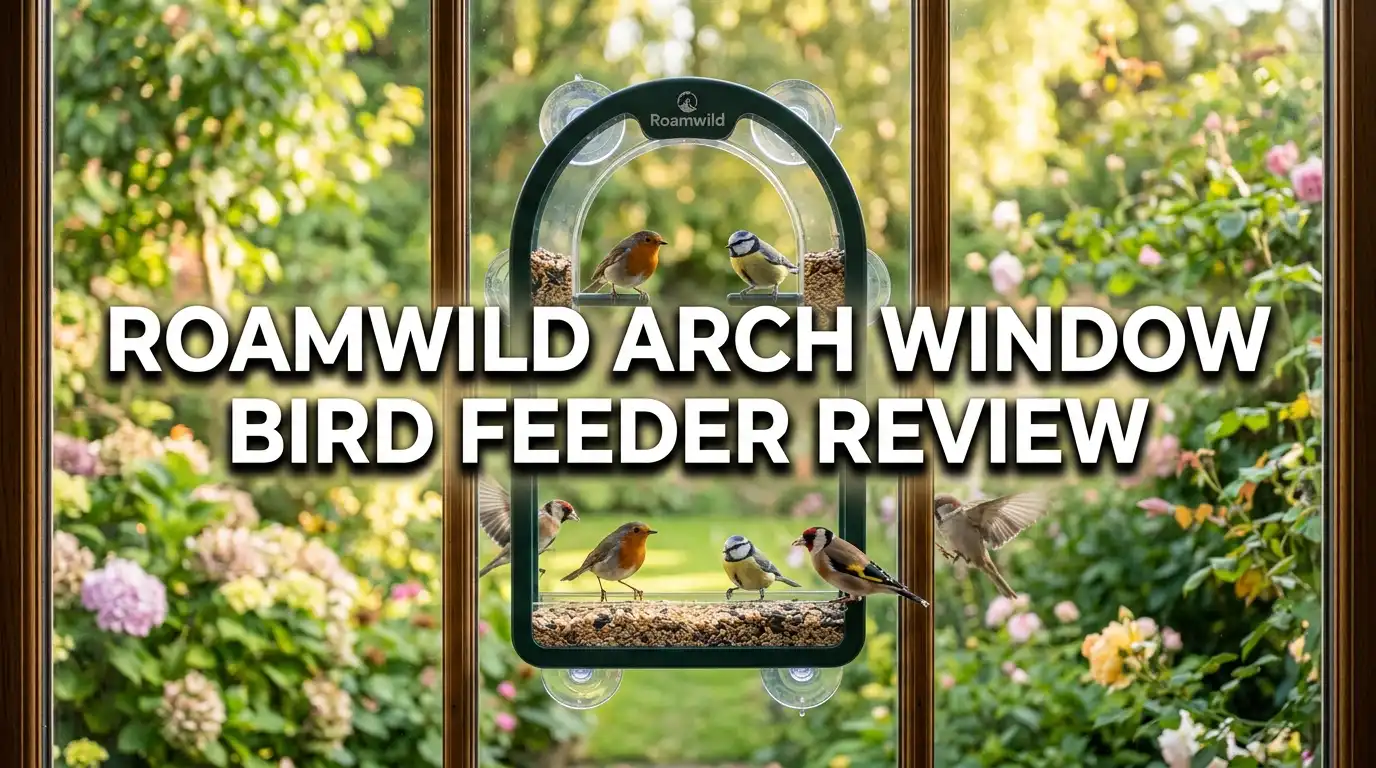
The Roamwild Arch Window Bird Feeder claims to fix all three problems. It uses vacuum lock suction clips instead of plain rubber cups. It holds four pounds of seed. It has an arched roof that shields the food from rain and snow.
This review covers what the Arch does well, where it frustrates people, and whether it deserves your money in 2026.
By the end, you will know if this feeder fits your window, your birds, and your budget.
Key Takeaways
- The vacuum lock mounting system is the standout feature. Two suction cups snap down with mechanical latches, creating an airtight seal. Independent testers watched it survive high winds and storms without shifting. This solves the single biggest complaint about window feeders.
- Capacity is class leading at four pounds, roughly eight cups or half a gallon. Most rivals hold two to three cups. You fill the Arch once a week instead of every other day, which matters most in winter when birds feed heavily.
- The arched roof keeps seed dry. The snap down lid and drainage holes work together. Testers reported the seed stayed bone dry during rain while open tray rivals soaked through.
- Cleaning is the weak spot. The narrow body needs a bottle brush. This is the most common real world complaint, and it is worth knowing before you buy.
- Large birds get partially excluded. Cardinals and finches feed comfortably. Bigger species struggle. Buy the optional cage accessory if starlings, pigeons, or squirrels raid your window.
- Verified rating sits around 4.6 out of 5 across 6,128 plus reviews, which is strong for a product category known for disappointing people.
Roamwild Arch Window Bird Feeder

- [BRING NATURE CLOSER - THE PERFECT GIFT FOR WILD BIRD LOVERS] – Includes ultra-strong unique...
- [KEEPS SEED FRESHER FOR LONGER & HUGE 4LBS CAPACITY & WEATHER RESISTANT] – Holds 4LBS of seed, so...
Last update on 2026-09-16 / Affiliate links / Images from Amazon Product Advertising API
The Arch is a polycarbonate window feeder built by Roamwild, a family owned company operating since 1990. The brand is better known for the PestOff squirrel proof tube feeder, and that engineering mindset carries over here.
Physical dimensions measure roughly 12 inches tall, 8 inches wide, and 6 inches deep. Empty weight sits at about 1.2 pounds. Filled, it carries four pounds of seed.
The shape is the first thing you notice. Instead of a clear rectangular box, you get a curved arch roof with sculpted proportions. Roamwild made a deliberate choice here.
Most window feeders try to disappear. The Arch tries to be seen. Whether you like that depends on your taste, but buyers consistently mention it as a compliment magnet.
The body uses crystal clear UV resistant polycarbonate. This material resists impact better than the thin acrylic used in budget feeders, and it does not yellow after a summer of direct sun.
Mounting relies on two suction cups with built in vacuum clips. Window protectors ship in the box to shield your glass. Seed is not included.
The tray lifts out for refilling and cleaning. The lid snaps down over the seed chamber. Drainage holes sit in the base of the tray.
The design goal is simple: a feeder that stays up, keeps food dry, and looks good doing it. The rest of this review tests that claim.
What Makes The Arch Design Different
Walk through any garden store and window feeders look identical. Clear plastic, flat roof, two cups, done. The Arch breaks from that template in three measurable ways.
First, the vertical orientation. The Arch stacks seed upward instead of spreading it sideways. This narrow footprint means it blocks less of your window view while holding more food.
Second, the roof geometry. The curved arch overhangs the feeding port. Rain runs off the sides instead of dripping into the seed chamber.
Third, visibility for birds. Fully transparent boxes can confuse birds and cause window strikes. The Arch has a defined silhouette that birds register as a solid object.
This last point deserves attention. The Cornell Lab of Ornithology recommends placing feeders within three feet of glass so birds approach slowly and cannot build up enough speed to injure themselves. A window mounted feeder sits at zero distance, which is the safest possible position.
There is a tradeoff to the tall narrow shape. When the feeder is completely full, the seed column partially blocks your sightline through the body.
Testers flagged this as a genuine drawback. You see the bird on the perch clearly. You see less through the feeder itself.
The arch also limits access for bigger species. Jays, doves, and grackles find the opening awkward.
For most buyers this is a feature, not a bug. Songbirds get a protected spot to feed while bullies go elsewhere.
Dual Suction Cup Vacuum Lock System Explained
This is the reason to consider the Arch over cheaper options, so it deserves a proper explanation.
A standard suction cup works by air pressure. You press it against glass, air escapes, and atmospheric pressure holds it. Temperature swings expand and contract the rubber, air seeps back in, and the seal weakens.
Add four pounds of seed and gravity finishes the job. Industry estimates suggest the majority of basic suction cup feeders fall within six months.
Roamwild adds a mechanical component. After you press the cup to the glass, you flip a latch that physically pulls the center of the cup away from the surface.
That action creates a stronger vacuum than hand pressure alone. It also locks the cup in a tensioned state so it cannot slowly relax.
Independent testing backs this up. The Bob Vila team mounted the Arch at roughly seven feet, left it through multiple storms, and rated durability a perfect 5 out of 5.
The feeder held fast during high winds and rain while a rival platform feeder with two plain cups struggled in the same conditions.
Cold weather is where cheap cups fail worst. Rubber stiffens near freezing and loses grip. The mechanical latch keeps tension regardless of temperature.
Two practical tips improve reliability. Clean the glass with rubbing alcohol before mounting, and press the cups on a warm dry day rather than in freezing rain.
Roamwild backs the mounting with a replacement promise if the feeder does not stay up. That guarantee tells you where their confidence sits.
Seed Capacity And Refill Schedule
Capacity sounds like a boring spec until you are standing outside in January with a scoop of sunflower hearts and numb fingers.
The Arch holds four pounds, which equals 2.1 quarts or eight cups. That is the largest capacity in the mainstream window feeder category by a wide margin.
Compare the field. The Nature Anywhere Birds I View holds 15 ounces. Nature’s Hangout holds 16 ounces. Most platform trays hold about the same.
That means the Arch carries roughly four times the seed of its closest competitors.
In practical terms, a busy winter feeder with regular chickadee, titmouse, and cardinal traffic will empty two cups a day. Eight cups gets you through most of a week.
During spring and summer, natural food is abundant and feeder traffic drops. The same fill can last two weeks or longer in warm months.
There is a caveat worth respecting. Bird health experts recommend emptying and cleaning feeders every two weeks regardless of how much seed remains.
Seed sitting in humid conditions can grow mold and spread disease through a local bird population. So the smart approach is to fill about three quarters full during summer.
Use the full capacity in deep winter when consumption is high and cold air keeps seed dry.
The practical benefit is fewer trips outside during the exact season you least want to make them. That alone justifies the design for many buyers.
Top 3 Alternative for Roamwild Arch Window Bird Feeder

- Watch Birds From Inches Away: The giant viewing hole and transparent acrylic put cardinals, finches...
- Suction Cups That Actually Hold: Four heavy duty EVERGRIP X4 suction cups grip clean glass for...
Last update on 2026-08-21 / Affiliate links / Images from Amazon Product Advertising API

- Extremely Durable: Nature’s Hangout’s window bird feeders for viewing is made of ¼ inch premium...
- A Thoughtful & Unique Gift: Bring the joy of up-close birdwatching to any home! Perfect bird...
Last update on 2026-08-21 / Affiliate links / Images from Amazon Product Advertising API

- SMALL WINDOW MOUNT: Bring the birds right outside your window with this small recycled window mount...
- RECYCLED MATERIALS: Poly lumber proudly made from recycled plastic jugs and bottles in the United...
Last update on 2026-09-16 / Affiliate links / Images from Amazon Product Advertising API
Build Quality And Materials
Material choice separates a feeder that lasts five years from one that cracks in eighteen months.
The Arch uses polycarbonate rather than acrylic. This matters more than marketing copy suggests.
Acrylic is cheaper and stays optically clear, but it is brittle. Drop an acrylic feeder on concrete and it shatters or spider cracks.
Polycarbonate absorbs impact. It flexes instead of fracturing, which is why it appears in safety glazing and riot shields.
Roamwild also specifies UV resistance. Untreated clear plastic exposed to a full summer of southern sun turns yellow and grows brittle at the edges.
Testers dropped the Arch onto grass, concrete, and gravel from roughly seven feet and it survived. Durability scored a perfect 5 out of 5 in that testing.
The moving parts feel solid. The lid snaps positively rather than resting loosely. The tray slides out with a click and seats firmly.
Empty weight of 1.2 pounds is substantial for a window feeder. That mass is a mixed blessing.
Heavier means sturdier, but it also loads the suction system harder. The vacuum lock design exists precisely because of this weight.
Verified buyers repeatedly describe the feeder as structurally sound and mention that units arrive undamaged and hold up through full seasons.
The company also has a track record. Roamwild has operated since 1990 and reports over 100,000 customers, with real people answering support requests.
Buy this feeder expecting several years of service rather than one season.
How To Install The Arch On Your Window
Installation takes about five minutes and most mistakes happen in the first two.
Start by choosing the right window. Pick a room where you sit daily, usually a kitchen or living room.
Shrubs or a small tree within about ten feet help enormously. Birds need cover to retreat to, and they scout a new feeder from nearby branches before committing.
Clean the glass properly. Wipe the mounting area with rubbing alcohol or glass cleaner and dry it completely.
Dust and window film are the number one cause of suction failure. Skipping this step undermines the entire vacuum lock system.
Apply the window protectors that ship in the box. These sit between the cups and your glass.
Press each suction cup firmly against the pane. Push out the trapped air with your thumb from the center outward.
Now flip the vacuum clips down. You should feel resistance as the latch tensions the cup. That resistance is the seal forming.
Mount at ground floor level only. Roamwild specifically advises against upper story installation, because refilling from a ladder is unsafe and a fall damages the feeder.
Partial shade beats direct sun. Full sun heats seed and accelerates spoilage.
Fill the tray, snap the lid down, and step back inside.
Expect patience next. Birds may arrive in hours or take weeks. Many buyers report a quiet five days followed by sudden heavy traffic.
Leave it up for at least three weeks before judging results.
Which Birds Visit The Arch Feeder
Feeder shape determines your guest list, and the Arch has clear preferences.
Small and medium songbirds dominate. Buyers consistently report chickadees, titmice, nuthatches, house finches, goldfinches, and cardinals.
Chickadees usually arrive first. They are bold, curious, and quick to test new food sources.
Cardinals take longer. They are larger and more cautious, but the arch roof gives them enough headroom to perch and crack seeds.
Woodpeckers and nuthatches visit when you offer peanut pieces or suet nuggets. Downy woodpeckers manage the perch surprisingly well.
Larger species struggle. Blue jays, doves, grackles, and pigeons find the opening restrictive.
Independent testing listed limited large bird access as a real drawback. Whether that bothers you depends on your goals.
Many people consider it the best feature of the feeder. Starlings and house sparrows can strip a feeder in an hour and drive smaller birds away.
Some buyers do report starlings arriving first and monopolizing the feeder. This happens most in suburban areas with established starling flocks.
The cage accessory solves that problem completely.
Hummingbirds will not use this feeder. It is a seed feeder only, so buy a dedicated nectar feeder for them.
Regional results vary. Northern buyers see juncos and pine siskins in winter. Southern buyers report Carolina wrens and painted buntings.
Set expectations around small colorful songbirds and you will be delighted.
Best Seed Types For This Feeder
Seed choice affects both which birds arrive and how much mess lands on your windowsill.
Black oil sunflower is the best all round option. The shells are thin, the oil content is high, and it attracts the widest variety of species.
Sunflower hearts are the smarter choice for a window feeder. There are no shells, so nothing piles up on your sill or below your window.
They cost more per pound but waste almost nothing. For a window installation, the cleanliness gain is worth the price difference.
Safflower is the cardinal magnet. Cardinals love it while squirrels and starlings generally dislike the bitter taste.
Nyjer seed brings in goldfinches and siskins. It flows well through the Arch because the grains are tiny.
Peanut pieces and suet nuggets attract woodpeckers, nuthatches, and titmice. Both work in this feeder and both suit cold weather feeding.
Mealworms bring in bluebirds and wrens. Dried mealworms mix well with sunflower hearts.
Avoid cheap supermarket mixes containing milo, wheat, cracked corn, and red millet. Birds throw those fillers on the ground and you clean them up.
The Arch handles all seed types thanks to its drainage holes and dry storage. That flexibility is genuinely useful.
One warning applies to fine seed in humid climates. Nyjer can clump if moisture gets in, so check it weekly during wet spells.
Start with sunflower hearts for the cleanest experience and add safflower if cardinals are your target.
Cleaning And Maintenance Routine
This is where the Arch loses points, and honesty matters more than enthusiasm here.
The feeder clicks apart for cleaning. The tray removes easily and the lid lifts off.
The tray is dishwasher safe, which handles the part that gets dirtiest.
The problem is the tall narrow seed chamber. You cannot reach into it with a cloth or a sponge.
Independent testers noted the narrowness requires a bottle brush and rated ease of use 4 out of 5 rather than 5. That single point deduction traces almost entirely to cleaning.
Buy a long handled bottle brush before your feeder arrives. A brush intended for water bottles or baby bottles works perfectly and costs a few dollars.
The recommended routine is straightforward. Every two weeks, empty remaining seed, disassemble, wash with warm water and mild soap, rinse thoroughly, and air dry completely before refilling.
Complete drying matters. Damp residue grows mold, and mold spreads salmonella and other diseases through bird populations.
Increase frequency during hot humid weather or after heavy rain. Reduce it slightly in dry freezing conditions.
Check the suction cups during each clean. Wipe the glass again before remounting.
Watch for seed bridging in the chamber. Tapping the side breaks up any clumps that stop seed from flowing to the tray.
Fifteen minutes every two weeks keeps the feeder healthy and your birds safe. The narrow body makes this slightly more work than a flat tray feeder, and that is a fair criticism.
The Optional Squirrel Proof Cage Accessory
Squirrels are the reason many people move to window feeders in the first place.
Window mounting alone defeats many squirrels. A feeder in the middle of a flat pane of glass with no branch or ledge nearby is genuinely hard to reach.
That protection is not absolute. Squirrels are athletic and creative, and a nearby deck rail, downspout, or shrub gives them a launch point.
Roamwild sells a clip on cage accessory for the Arch. It sold separately and requires no tools.
The cage sizes its openings so small songbirds pass through while squirrels cannot. It uses the same principle as their PestOff tube feeder.
The cage also blocks starlings and pigeons, which solves the bully bird problem at the same time.
Roamwild designed the bars to keep views clear rather than obscuring the birds you are trying to watch.
This is worth budgeting for if you live in a suburb with heavy squirrel activity, or if you have already lost feeders to them.
Skip it if your window sits on a bare wall with no climbing route and you have not seen squirrels attempt an approach.
Reddit bird feeding communities rate Roamwild squirrel resistant designs highly, with users reporting that squirrels cannot chew through the materials.
Factor the cage into your total cost if squirrels are a known problem at your address. The Arch alone will not stop a determined one with a launch point.
Weather Performance Across Four Seasons
A window feeder faces weather directly with no tree canopy above it.
Rain is the first test. The arched roof overhangs the feeding port and the snap down lid seals the seed chamber.
Testers confirmed seed stayed dry through storms that soaked open tray competitors. Drainage holes in the tray let any water that does enter escape.
Snow performs similarly. The curved roof shape sheds snow rather than collecting it.
Cold is the real challenge for suction mounting. Rubber hardens near freezing and standard cups release.
The mechanical vacuum clips maintain tension independent of rubber flexibility. Roamwild states the system holds from summer heat through freezing winter, and buyer reports through northern winters support this.
Wind resistance benefits from the two point mounting and the low profile against the glass. The feeder sits flush rather than swinging like a hanging feeder.
Summer heat brings a different concern. Direct sun degrades seed oil and can make sunflower hearts turn rancid.
Mount on a north or east facing window if you can. Partial shade extends seed freshness noticeably.
UV exposure is where cheap feeders die. Polycarbonate with UV treatment resists yellowing and cracking that ruins thin acrylic within a season or two.
Ice storms deserve one caution. Check your mounting after any severe freeze and thaw cycle.
Overall weather performance is the Arch’s second strongest attribute after capacity. The roof and lid combination genuinely works.
Pros And Cons
Pros
- Vacuum lock suction clips actually hold. The mechanical latch creates a seal that survives temperature swings, wind, rain, and a full four pound load. This addresses the single biggest failure point in the category.
- Four pound capacity leads the class. Eight cups of seed means weekly refills instead of every other day, which matters most during winter feeding.
- The arch roof keeps seed dry. The snap down lid plus drainage holes protected seed through storms in independent testing while open rivals got soaked.
- Polycarbonate construction resists impact and UV damage. Testers dropped it on concrete and gravel from window height without damage, and it earned a perfect durability score.
- The decorative arch looks good on a window. Buyers report neighbors and visitors commenting on it, which no clear plastic box achieves.
- A squirrel proof cage accessory is available. No major competitor offers this option.
- Strong verified rating around 4.6 out of 5 across 6,128 plus reviews, with responsive customer service reported repeatedly.
Cons
- The narrow chamber is harder to clean. You need a bottle brush, and this costs the feeder a point in usability ratings.
- Large birds get limited access. Jays, doves, and grackles find the opening awkward, so your species variety narrows.
- A full feeder partially blocks your view through the body. The seed column sits between you and the far side.
- The cage costs extra. Full squirrel protection is not included in the base price.
- Ground floor mounting only. Roamwild advises against upper story installation.
- Two suction cups rather than four. The mechanism compensates, but some buyers prefer more contact points.
Price And Value In 2026
Window feeders in this category run roughly 15 to 40 dollars, and the Arch sits at the upper end of that range.
Prices shift with promotions and stock, so check current listings before deciding. Roamwild sells direct with free shipping from Ohio, and the feeder appears on Amazon and Walmart as well.
The value calculation is not just sticker price. Consider replacement cost.
A 20 dollar feeder that falls and cracks after five months costs 40 dollars a year. A 35 dollar feeder that lasts four years costs under nine dollars a year.
Independent testers rated the Arch 5 out of 5 for value despite it not being the cheapest option. Durability and capacity drove that score.
Seed economics add up too. A feeder with a roof wastes less seed to rain and wind, and one that excludes bully birds loses less seed to starling flocks.
Sunflower hearts run several dollars per pound. Saving even a pound a month covers the price premium quickly.
Budget the cage accessory separately if squirrels are an issue at your address.
Where the Arch does not represent good value is if you want maximum bird variety on a small budget. Nature’s Hangout costs less and welcomes more species.
The Arch is priced as a long term purchase and it performs like one. That said, prices and availability change, so verify current numbers yourself.
Who Should Buy The Arch And Who Should Skip It
Clear guidance saves you a return.
Buy the Arch if you live in an apartment, condo, or home without a yard. It mounts on any smooth glass, including double glazed, tinted, and low E windows.
Buy it if you have already lost a window feeder to falling suction cups. The vacuum lock system exists specifically to fix that.
Buy it if you hate frequent refills. The four pound capacity is unmatched in this category.
Buy it if you feed birds through harsh winters. The roof, the lid, and the cold resistant mounting all matter more in January than July.
Buy it if you want a feeder that looks intentional on your window rather than one you hope nobody notices.
Skip it if your priority is attracting the widest possible variety of birds, including jays and doves. Choose the Nature Anywhere Birds I View or a platform feeder instead.
Skip it if you want the absolute clearest unobstructed view through the feeder body.
Skip it if you dislike scrubbing narrow containers. A flat tray feeder cleans in thirty seconds.
Skip it if you only have upper story windows. Roamwild advises ground level mounting.
Skip it if your budget is tight and you just want to test whether window feeding works for you. Start cheap, then upgrade.
Most people who sit near a ground floor window and want reliable songbird traffic will be happy with this feeder.
Final Verdict
- [BRING NATURE CLOSER - THE PERFECT GIFT FOR WILD BIRD LOVERS] – Includes ultra-strong unique...
- [KEEPS SEED FRESHER FOR LONGER & HUGE 4LBS CAPACITY & WEATHER RESISTANT] – Holds 4LBS of seed, so...
Last update on 2026-09-16 / Affiliate links / Images from Amazon Product Advertising API
The Roamwild Arch Window Bird Feeder earns a recommendation with two honest caveats.
It solves the two problems that ruin window feeding for most people. It stays on the glass, and it holds enough seed to be practical.
The vacuum lock clips are real engineering rather than marketing language. Independent testers rated durability a perfect score after storm exposure and drop tests.
The four pound capacity is four times what most rivals hold. The arched roof keeps that seed dry.
Build quality reflects a company that has made feeders since 1990. UV resistant polycarbonate is the right material choice, and buyers report multiple seasons of service.
The caveats are the narrow cleaning access and the limited large bird welcome. Buy a bottle brush and adjust your expectations, and neither becomes a dealbreaker.
If squirrels or starlings raid your window, budget for the cage accessory. That combination makes the Arch close to unbeatable in this category.
A 4.6 out of 5 average across more than 6,128 verified reviews reflects genuine satisfaction in a product category with a reputation for disappointing people.
Verdict: a strong buy for anyone who wants a window feeder that stays up, holds a week of seed, and brings songbirds within inches of the glass.
Check current pricing before you order, since promotions and stock levels change frequently.
Frequently Asked Questions
How much seed does the Roamwild Arch hold?
It holds four pounds of seed, which equals 2.1 quarts or eight cups. That is roughly four times the capacity of typical window feeders, so most people refill once a week rather than every other day.
Will the suction cups fall off in winter?
Roamwild uses dual suction cups with mechanical vacuum clips rather than plain rubber. The latch maintains tension regardless of temperature, and the system holds through freezing conditions and summer heat. Clean the glass with rubbing alcohol before mounting for best results.
Does rain get into the seed?
No. The arched roof overhangs the feeding port, the lid snaps down over the seed chamber, and drainage holes let any moisture escape. Independent testers confirmed the seed stayed dry through storms.
What is the feeder made of?
The body uses crystal clear UV resistant polycarbonate. This material resists impact better than acrylic and does not yellow or crack after sun exposure.
Can squirrels get into it?
Window mounting alone stops many squirrels, but a determined one with a nearby launch point can reach it. Roamwild sells an optional clip on cage accessory that blocks squirrels, starlings, and pigeons while songbirds pass through freely.
Which birds will use this feeder?
Expect chickadees, titmice, nuthatches, finches, goldfinches, and cardinals. Woodpeckers visit when you offer peanut pieces or suet nuggets. Larger birds such as jays and doves find the opening restrictive.
How long until birds find it?
Some buyers see birds within hours. Others wait several days or weeks. Many report a quiet five day period followed by sudden heavy traffic. Nearby shrubs or trees speed the process considerably.
Is it hard to clean?
The tray removes easily and is dishwasher safe, but the tall narrow chamber needs a bottle brush. This is the most common complaint about the feeder. Clean it every two weeks with mild soap and dry it fully before refilling.
Can I use it in an apartment?
Yes. It mounts directly on any smooth glass, including single pane, double glazed, tinted, and low E windows. No yard is required. Roamwild advises ground floor mounting only.
What seed works best?
Sunflower hearts give the cleanest result because there are no shells to pile up on your sill. Black oil sunflower attracts the widest variety. Safflower brings cardinals. Avoid cheap mixes with milo and wheat.

Luna is the passionate founder and author of Birds and You, a website dedicated to sharing her love for birds with fellow enthusiasts. Through her engaging articles and guides, she aims to educate and inspire others to explore the fascinating world of birds. When she’s not writing, you can find Luna observing birds in their natural habitats or sharing beautiful bird photography on Pinterest. Join her on this journey to celebrate and protect our feathered friends!